
Countertop guide
Quartz vs. Quartzite Countertops: What's the Difference?
The short answer
Quartz is an engineered slab made mostly of crushed quartz bound with resin. Quartzite is a natural stone, quarried in blocks and cut into slabs. Quartz gives you a consistent pattern and needs no sealing. Quartzite gives you one-of-a-kind veining, copes better with heat and sun, and usually needs periodic sealing. Pick quartz if you want predictability and easy care; pick quartzite if you want natural character.
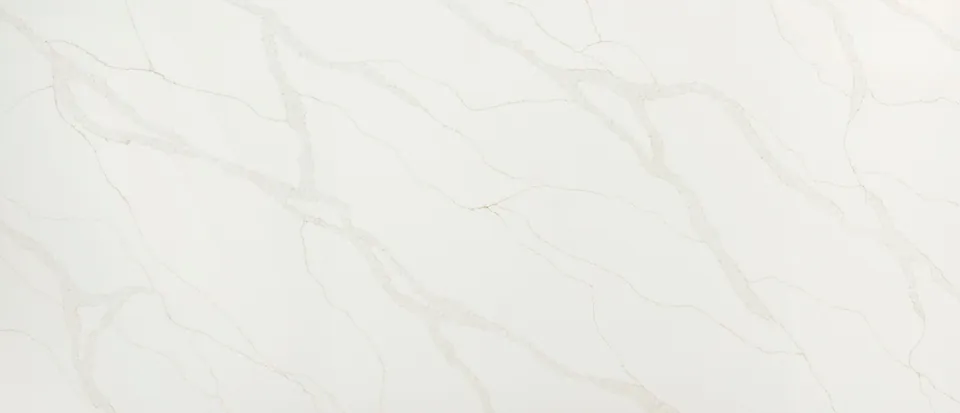 Manufacturer image · MSI
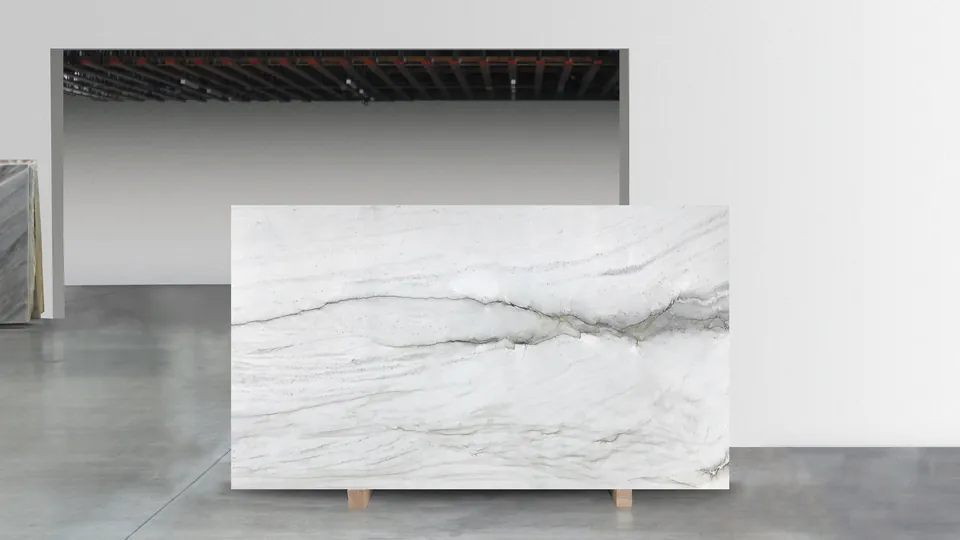 Manufacturer image · NSR
Quartz and quartzite at a glance
| Feature | Quartz | Quartzite |
|---|---|---|
| Origin | Engineered: ground quartz, resin and pigment | Natural stone, quarried and cut into slabs |
| Pattern | Consistent from slab to slab | Unique to every slab |
| Sealing | Not needed | Usually recommended for working counters |
| Heat | Use trivets; the resin is the weak point | Handles heat better; trivets still advised |
| Outdoors | Not recommended by MSI | Suited to outdoor kitchens, per MSI |
General characteristics. Care and suitability vary by product and slab, so check the supplier's guidance for yours.
How each one is made
MSI describes its quartz slabs as typically 93 to 95 percent quartz crystals, bound with resin and colored with pigments (MSI Surfaces). Because the slab is manufactured, the color and veining are designed and repeatable.
Quartzite starts as sandstone. Heat and pressure over a very long time fuse the quartz grains into a dense, hard stone, which is then quarried and cut into slabs (MSI Surfaces). Nothing about the pattern is planned, which is the appeal.
Looks and slab-to-slab variation
With quartz, the sample you hold is a reliable preview of the slab that arrives. That makes it easy to match pieces across a long perimeter or a second room.
With quartzite, two slabs sold under the same name can look quite different, and a single slab changes from one end to the other. We suggest seeing the actual slab before you commit, and planning where the strongest veining should land on an island or a waterfall end.
Heat, sunlight and outdoor kitchens
MSI asks for a trivet or hot pad between its quartz and anything hot, and notes that sudden or sustained heat, especially near edges and cutouts, can crack the slab (MSI Surfaces). MSI also does not recommend quartz for outdoor use (MSI Surfaces).
Quartzite is more comfortable with heat, and MSI lists outdoor kitchens among the places it works well (MSI Surfaces). If you're planning an outdoor kitchen, that difference usually decides it.
Care and sealing
Quartz needs no sealing. MSI points out that a sealer can't soak into quartz, so it sits on the surface and wears off unevenly (MSI Surfaces).
For quartzite used as a daily kitchen counter, MSI recommends a penetrating sealer (MSI Surfaces). How often depends on the stone and how hard the counter works. Our stone care guide covers the routine for both.
Which one should you choose?
- Choose quartz for a consistent look, the simplest upkeep and an indoor kitchen or bath.
- Choose quartzite for natural veining, a statement island, or counters near heat or outdoors.
- Not sure? Many kitchens use both: quartzite on the island, quartz on the working perimeter.
FAQ
Common questions
Can you tell quartz and quartzite apart just by looking?
Not always, since many quartz designs imitate quartzite. Quartz usually repeats its pattern evenly, while quartzite varies across the slab and has the depth of natural crystal. The supplier's product listing settles it.
Does quartzite etch like marble?
MSI notes that quartzite doesn't react to acidic foods the way marble does. Stones vary, though, so we review care for the specific slab you choose before fabrication.
Can both be used for a waterfall island?
Yes. Both can be mitered so the top runs down the side of the island. We plan the vein layout and fabricate the miter in-house.
Sources
Material properties on this page come from these supplier and industry pages, checked November 1, 2026.
Free in-home estimate
Talk it through in your own kitchen.
We come to you, measure, and help you weigh the options. The estimate is free, with no obligation.